
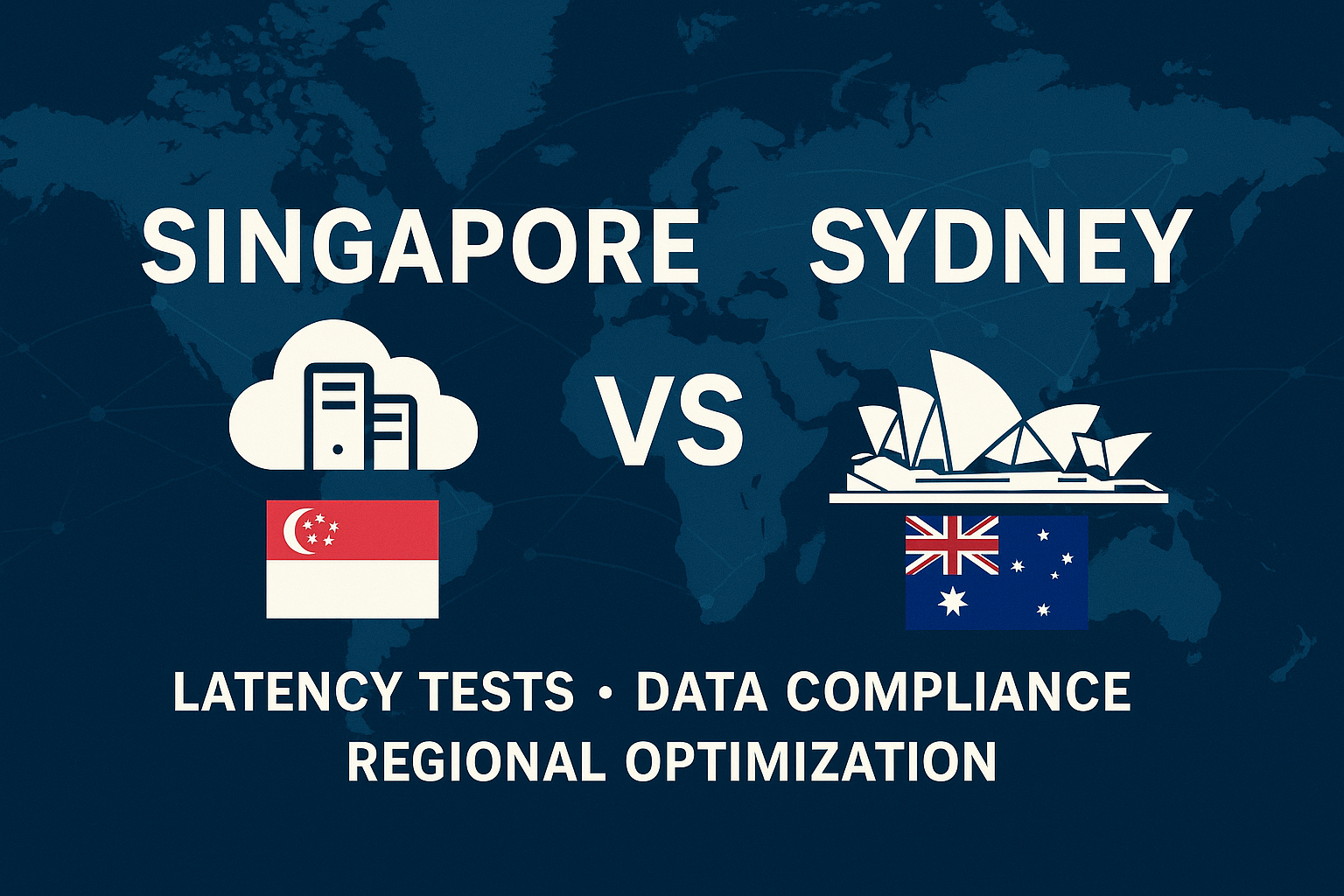
The Asia-Pacific region presents unique challenges for selecting the optimal VPS location. With Singapore emerging as a financial and tech hub alongside Sydney’s established infrastructure, choosing between these locations can significantly impact your application’s performance, compliance posture, and user experience across APAC markets.
This comprehensive analysis examines real-world performance metrics, regulatory considerations, and connectivity patterns to help you make an informed decision for your APAC deployments.
Latency Performance Benchmarks
Network latency forms the foundation of user experience across APAC. Our testing reveals distinct performance patterns between Singapore and Sydney VPS deployments:
Singapore Connectivity Metrics
- Hong Kong: 35-42ms average latency
- Tokyo: 65-75ms via submarine cable routes
- Mumbai: 55-65ms through direct fiber connections
- Jakarta: 20-30ms leveraging regional peering
- Bangkok: 25-35ms with excellent terrestrial routing
Sydney Connectivity Patterns
- Melbourne: 15-25ms domestic fiber performance
- Auckland: 25-35ms trans-Tasman connectivity
- Tokyo: 110-130ms Pacific cable routing
- Hong Kong: 125-145ms indirect routing paths
- Seoul: 140-160ms via submarine cables
Singapore demonstrates superior connectivity to Southeast Asian markets and financial centers, while Sydney excels in Australia-New Zealand domestic performance. The choice depends heavily on your primary user base distribution.
Data Residency and Compliance Frameworks
Regulatory compliance significantly influences VPS location selection in APAC, with distinct frameworks governing data handling in each jurisdiction.
Singapore PDPA Requirements
Singapore’s Personal Data Protection Act (PDPA) establishes comprehensive data protection standards without strict data localization requirements. Key considerations include:
- Cross-border transfers: Permitted with adequate safeguards
- Consent mechanisms: Clear opt-in requirements for data collection
- Breach notification: Mandatory reporting within specific timeframes
- Data retention: Purpose limitation and retention scheduling
Australian Privacy Act Implications
Australia’s Privacy Act 1988 and Australian Privacy Principles (APPs) create specific obligations for data handling:
- Offshore disclosure: Requires reasonable steps to ensure compliance
- Notifiable data breaches: Mandatory notification scheme
- Data sovereignty: Government preference for domestic hosting
- Sectoral requirements: Banking and healthcare may mandate local storage
For organizations serving Australian customers or handling sensitive data, Sydney VPS deployment may provide clearer compliance pathways and reduced regulatory risk.
Peering Infrastructure and Connectivity
Both Singapore and Sydney serve as critical internet exchange points, but with different strengths and connectivity patterns.
Singapore Internet Exchange Advantages
Singapore’s strategic location creates exceptional peering opportunities:
- SGIX connectivity: Over 200 networks with diverse routing options
- Submarine cable density: Multiple trans-Pacific and regional systems
- Financial market proximity: Direct connections to trading venues
- Content delivery: Major CDN presence for regional distribution
Sydney Peering Ecosystem
Sydney offers robust domestic connectivity with growing international presence:
- PIPE Networks: Extensive Australian fiber infrastructure
- IX Australia: Primary internet exchange with major carriers
- Tier-1 presence: Direct connections to global internet backbones
- Government networks: Preferred location for public sector connectivity
APAC Workload Optimization Strategies
Different application types benefit from specific location strategies based on user distribution and performance requirements.
Optimal Singapore Use Cases
- Financial trading platforms: Proximity to major exchanges and low-latency requirements
- Southeast Asian applications: Central location for regional user bases
- API gateways: Hub for cross-regional service integration
- Content distribution: Strategic position for APAC CDN deployment
Sydney Optimization Scenarios
- Australian domestic services: Compliance and performance for local users
- Government applications: Data sovereignty and regulatory alignment
- Trans-Tasman operations: Australia-New Zealand business requirements
- Resource-intensive workloads: Competitive pricing for compute resources
Multi-Region Deployment Considerations
Many organizations benefit from deploying across both locations to maximize coverage and resilience. Consider implementing:
- GeoDNS routing: Automatic traffic direction based on user location
- Database replication: Cross-region data synchronization for failover scenarios
- Load balancing: Intelligent distribution across both Singapore and Sydney endpoints
- Compliance segmentation: Region-specific data handling based on regulatory requirements
This approach provides optimal user experience while maintaining compliance flexibility and infrastructure resilience across the APAC region.
Performance Testing and Validation
Before committing to a deployment location, conduct comprehensive testing using tools like Netdata for real-time monitoring and iperf3 for network performance validation. Consider factors including:
- Peak hour performance: Test during regional business hours
- Mobile network connectivity: Validate performance across carrier networks
- Failover scenarios: Measure recovery times and data synchronization
- Compliance validation: Verify data flow patterns meet regulatory requirements
The choice between Singapore and Sydney VPS ultimately depends on your specific requirements for latency, compliance, and target audience distribution. Singapore offers superior connectivity to Southeast Asian markets and financial infrastructure, while Sydney provides optimal performance for Australian domestic applications with clearer regulatory pathways.
For applications serving diverse APAC markets, consider a multi-region approach leveraging both locations to maximize performance and regulatory compliance across the region.